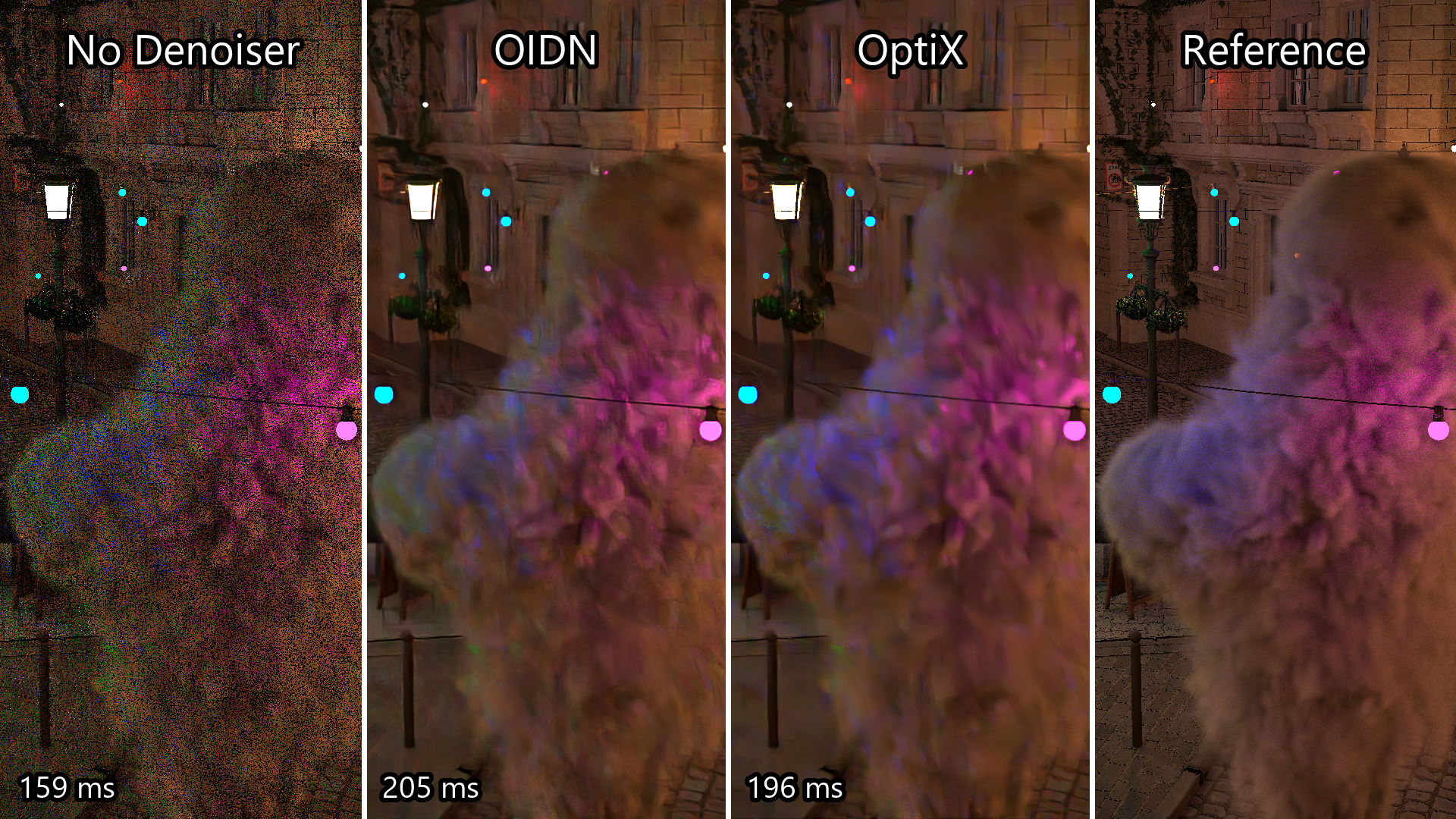
This project investigates the trade-off between denoising strength and additional Volumetric ReSTIR sampling under a fixed compute budget. Real-time volumetric rendering pipelines often rely on denoising to suppress noise, but Volumetric ReSTIR itself is designed to produce low variance samples by reusing light transport paths across space and time.
The core research question addressed is: "Under a fixed frame-time budget, is it more effective to spend compute on stronger denoising, or to allocate that budget to improved Volumetric ReSTIR sampling?"
To answer this, we extended the original Volumetric ReSTIR codebase with multiple denoising configurations (OIDN, OptiX) and performed controlled comparisons across different scenes and camera motions.
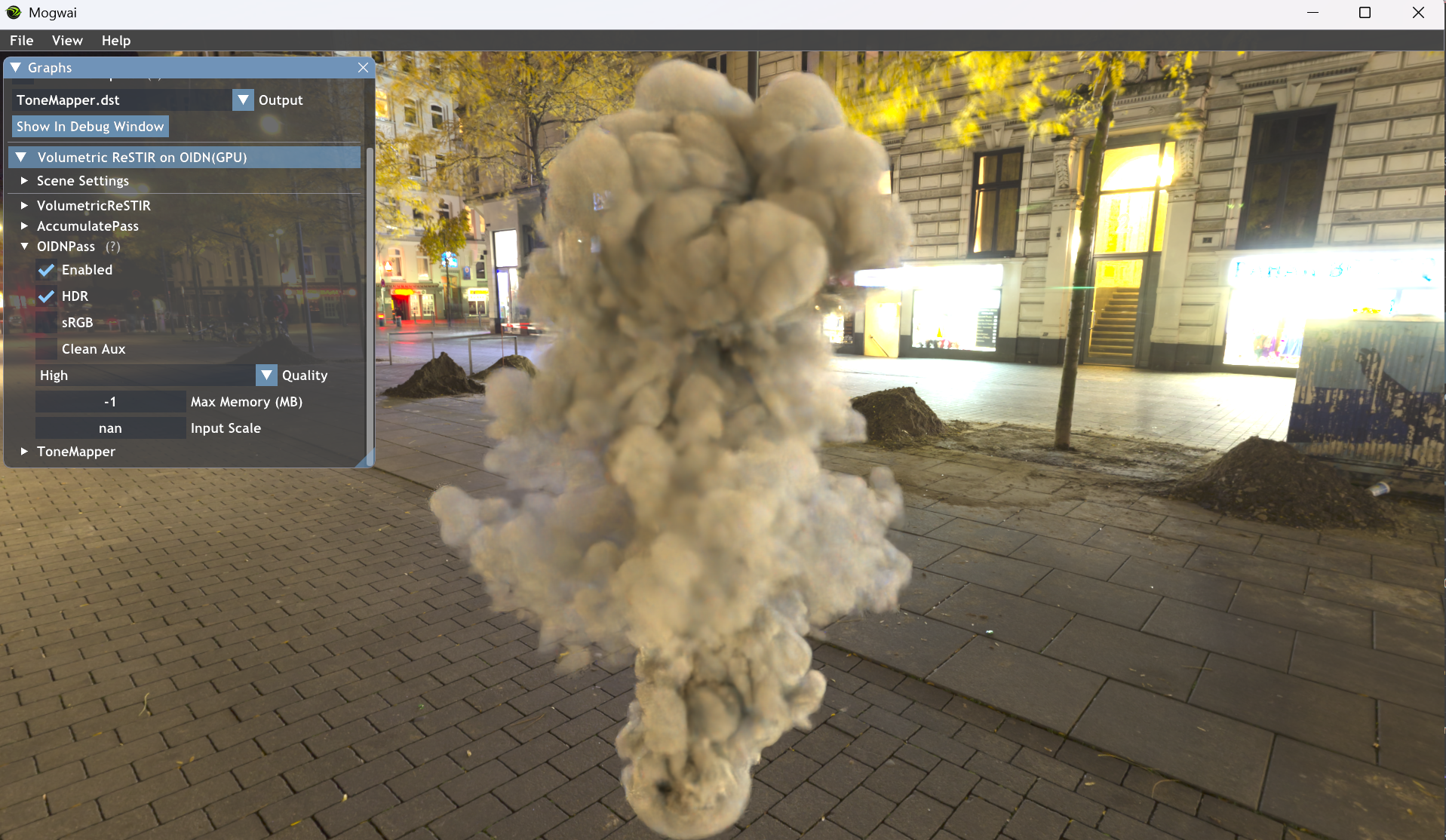
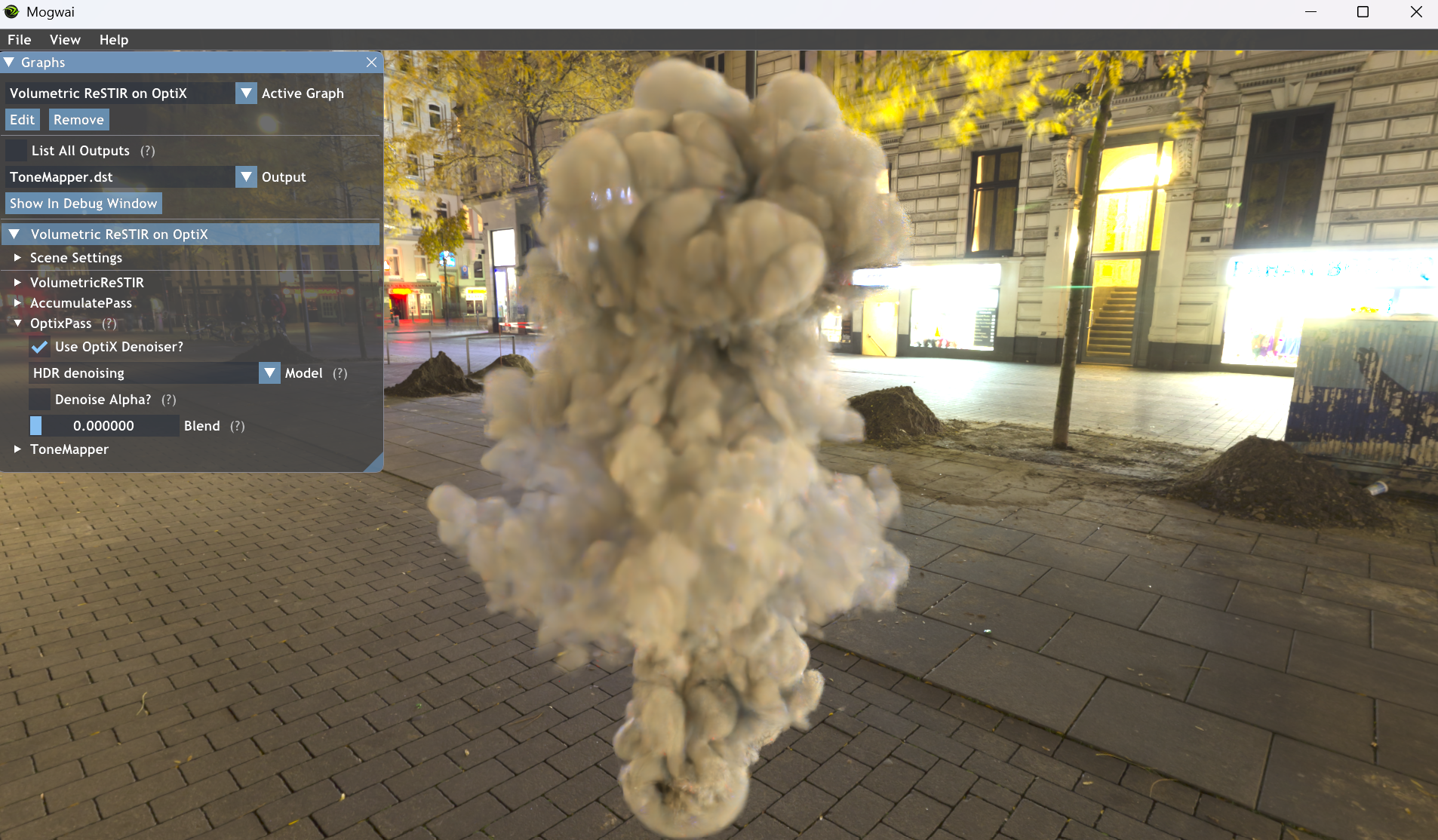
The work builds upon the original implementation of Volumetric ReSTIR by Lin et al. (2021). We integrated the following denoisers as render passes within the Falcor pipeline:
Simple Scene (Plume): A single volumetric plume illuminated by an
environment map. This setup isolates denoiser behavior in participating media without
surface occlusions.
Complex Scene (Amazon Bistro): A geometrically dense environment populated
with fog and over 20,000 emissive triangles, introducing complex visibility, occlusion, and
lighting interactions.
[Lin 2021] Lin, D., Wyman, C. and Yuksel, C., 2021. Fast volume rendering with spatiotemporal reservoir resampling. ACM Transactions on Graphics (TOG), 40(6), pp.1-18.
[Bitterli 2020] Bitterli, B., Wyman, C., Pharr, M., Shirley, P., Lefohn, A. and Jarosz, W., 2020. Spatiotemporal reservoir resampling for real-time ray tracing with dynamic direct lighting. ACM Transactions on Graphics (TOG), 39(4), pp.1-17.
[Andersson 2020] Andersson, P., Nilsson, J., Akenine-Möller, T., Oskarsson, M., Åström, K. and Fairchild, M.D., 2020. FLIP: A Difference Evaluator for Alternating Images. Proc. ACM Comput. Graph. Interact. Tech., 3(2), pp.1-23.
[Schied 2017] Schied, C., Kaplanyan, A., Wyman, C., Patney, A., Chaitanya, C.R.A., Burgess, J., Liu, S., Dachsbacher, C., Lefohn, A. and Salvi, M., 2017. Spatiotemporal variance-guided filtering: real-time reconstruction for path-traced global illumination. Proceedings of High Performance Graphics (HPG).
[Zhu 2023] Zhu, S., Zhang, X., Röthlin, G., Papas, M. and Meyer, M., 2023. Denoising Production Volumetric Rendering. ACM SIGGRAPH 2023 Talks.
[Kutz 2017] Kutz, P., Habel, R., Li, Y.K. and Novák, J., 2017. Spectral and decomposition tracking for rendering heterogeneous volumes. ACM Transactions on Graphics (TOG), 36(4), pp.1-16.
[Novák 2014] Novák, J., Selle, A. and Jarosz, W., 2014. Residual ratio tracking for estimating attenuation in participating media. ACM Transactions on Graphics (TOG), 33(6), pp.1-11.
[NVIDIA 2025] NVIDIA, 2025. NVIDIA OptiX AI-Accelerated Denoiser. Version 9.0.
[Intel 2025] Intel, 2025. Intel Open Image Denoise. Version 2.3.3.
[Falcor 2020] Benty, N., Yao, K.H., Clarberg, P., Chen, L., Kallweit, S., Foley, T., Oakes, M., Lavelle, C. and Wyman, C., 2020. The Falcor Rendering Framework.
[NRD 2025] NVIDIA, 2025. NVIDIA Real-Time Denoisers (NRD).